

Description
The CANchecked TCC10 Thermocouple CAN Converter is the flagship ten-channel member of the TCCXX family, designed to provide high-channel-count temperature monitoring through direct CAN bus communication.
Manufactured in Germany, the TCC10 supports up to ten Type-K thermocouples, making it ideal for motorsport, high-performance, and advanced vehicle applications where multiple temperature parameters need to be monitored simultaneously and transmitted reliably across a CAN network.
Unlike analog thermocouple converters that rely on a 0–5V output, the TCC10 transmits temperature data digitally over the CAN bus for clean integration with compatible ECUs, data loggers, displays, and other CAN-enabled devices.
Each thermocouple channel features cold-junction compensation, a measurement range of 0 to 1250°C, and 0.25°C / 14-bit resolution for detailed temperature monitoring.
The TCC10 also features integrated WLAN connectivity, allowing users to configure CAN communication settings, update firmware, and view real-time temperature data and thermocouple status from a compatible smartphone or PC.
Fitment
Universal Application
The CANchecked TCC10 is designed for a wide range of vehicle and motorsport applications, including:
- Motorsport and race vehicles
- High-performance vehicles
- Turbocharged and forced-induction applications
- Custom vehicle builds
- Advanced engine monitoring systems
- Vehicles equipped with compatible aftermarket ECUs
- CAN bus-based data acquisition systems
The ten thermocouple channels can be used for monitoring exhaust gas temperature (EGT), intercooler temperatures, cylinder head temperatures, water temperature, oil temperature, and other critical thermal parameters.
Compatibility depends on the connected ECU, CAN bus configuration, communication protocol, and thermocouple setup.
What's Included
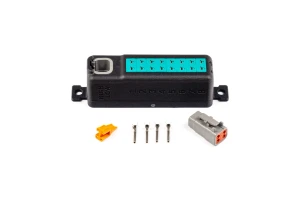
- 1 × CANchecked TCC10 Thermocouple CAN Converter
- 1 × Integrated 4-Pin DTM CAN Bus Connection
Key Features
- Ten Type-K Thermocouple Inputs: Supports up to ten Type-K thermocouples for simultaneous temperature monitoring.
- Direct CAN Bus Output: Transmits thermocouple data digitally over CAN instead of using an analog 0–5V output.
- 0–1250°C Measurement Range: Suitable for a wide range of automotive and motorsport temperature monitoring applications.
- Cold-Junction Compensation: Provides compensated thermocouple measurements.
- 0.25°C Resolution: Provides high-resolution 14-bit temperature measurement.
- CAN 2.0A/B Support: Compatible with standard CAN 2.0A/B communication.
- Selectable CAN Speeds: Supports 125 kbps, 250 kbps, 500 kbps, and 1 Mbps.
- Configurable Byte Order: Supports selectable Big Endian or Little Endian data formats.
- Multiple Emulation Modes: Supports Standard, MoTeC, Haltech, ECUMaster, and AEMnet emulation modes.
- Wide ECU Compatibility: Designed for integration with compatible systems from Emtron, MaxxECU, MoTeC, Haltech, ECUMaster, LinkECU, and other CAN-enabled platforms.
- WLAN Connectivity: Enables wireless configuration, firmware updates, live data monitoring, and thermocouple status monitoring.
- DTM 4-Pin Connection: Provides a compact and robust connection for CAN bus and power.
- Miniature K-Type Connections: Designed for connecting Type-K thermocouples.
- Made in Germany: Manufactured in Germany using advanced engineering processes.
Specifications
- Brand: CANchecked
- Product: TCC10 Thermocouple CAN Converter
- Product Type: 10-Channel Thermocouple CAN Converter
- Application: Universal
- Thermocouple Type: Type-K
- Thermocouple Channels: Up to 10
- Temperature Range: 0°C to 1250°C
- Resolution: 0.25°C
- Measurement Resolution: 14-bit
- Cold-Junction Compensation: Yes
- CAN Standard: CAN 2.0A/B
- CAN Speeds: 125 / 250 / 500 kbps / 1 Mbps
- Byte Order: Big Endian / Little Endian
- Emulation Modes: Standard / MoTeC / Haltech / ECUMaster / AEMnet
- Connectivity: CAN Bus / WLAN
- CAN Connector: 4-Pin DTM
- Thermocouple Connectors: Miniature K-Type
- Manufacturing Location: Germany
Thermocouple Temperature Monitoring
The TCC10 provides ten independent Type-K thermocouple inputs, allowing multiple temperature parameters to be monitored simultaneously.
Depending on the vehicle and installation, the channels can be used to monitor exhaust gas temperature, pre- and post-intercooler temperatures, cylinder head temperature, coolant temperature, oil temperature, and other critical operating temperatures.
With a measurement range from 0 to 1250°C and 0.25°C resolution, the TCC10 provides detailed thermal data for performance monitoring, diagnostics, tuning, and motorsport data acquisition.
CAN Bus Integration
The TCC10 transmits thermocouple measurements directly over the CAN bus, eliminating the need to convert each temperature channel into a separate analog 0–5V signal.
CAN communication supports CAN 2.0A/B with selectable speeds of 125 kbps, 250 kbps, 500 kbps, or 1 Mbps. Big Endian and Little Endian byte order can also be configured according to the requirements of the connected system.
Multiple emulation modes provide compatibility with CAN-based systems from manufacturers including MoTeC, Haltech, ECUMaster, AEMnet, Emtron, MaxxECU, and LinkECU, depending on the specific configuration.
WLAN Connectivity
The integrated WLAN interface allows the TCC10 to be configured wirelessly from a compatible smartphone or PC.
Users can adjust CAN communication speed, select emulation modes, configure CAN bus IDs, perform firmware updates, and monitor live temperature data and thermocouple status without requiring additional configuration hardware.
Installation
The TCC10 connects to the vehicle's CAN bus through its 4-pin DTM connector, while the thermocouples connect through the dedicated miniature K-type connectors.
For best results, installation should be performed by a qualified technician familiar with automotive CAN bus systems, thermocouple wiring, and the requirements of the connected ECU or data acquisition system.