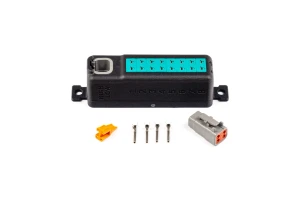


Description
The CANchecked TCC04 Thermocouple CAN Converter is a compact, motorsport-grade temperature monitoring module designed to connect and monitor up to four Type-K thermocouples through direct CAN Bus communication. It provides accurate digital temperature data for high-performance street cars, race cars, motorsport applications, and custom vehicle electronics.
By transmitting temperature measurements directly over the CAN Bus, the TCC04 eliminates the need to rely on traditional analog sensor inputs and provides a clean digital connection to compatible ECUs, data loggers, digital displays, and other CAN-enabled vehicle systems. The converter is suitable for monitoring critical temperatures such as exhaust gas, charge air, coolant, oil, and cylinder head temperatures.
Each channel features cold-junction compensation and high-resolution 14-bit measurement capability across a temperature range of 0°C to 1250°C, providing detailed temperature information for performance monitoring, tuning, and diagnostics.
Integrated WiFi connectivity allows the TCC04 to be configured and monitored wirelessly using a smartphone, tablet, or computer. CAN Bus speeds, communication protocols, CAN IDs, and emulation modes can be configured through the wireless interface, simplifying setup and integration with aftermarket electronics.
The CANchecked TCC04 supports CAN 2.0A/B communication with configurable CAN Bus speeds from 125 kbps to 1 Mbps. It is compatible with a wide range of CAN-enabled systems and aftermarket ECU platforms, making it a flexible solution for applications requiring multiple high-temperature inputs.
Key Features
- Supports up to 4 Type-K thermocouples
- Direct digital CAN Bus temperature communication
- Temperature measurement range from 0°C to 1250°C
- Cold-junction compensated temperature readings
- High-resolution 14-bit measurement
- Integrated WiFi connectivity
- Wireless configuration and live temperature monitoring
- Configurable CAN Bus speeds from 125 kbps to 1 Mbps
- CAN 2.0A/B compatibility
- Configurable CAN IDs and communication protocols
- Supports emulation modes
- Integrated 4-pin DTM CAN Bus connection
- Designed for high-performance and motorsport applications
- Compatible with CAN-enabled ECUs and electronic systems
- Suitable for EGT, coolant, oil, intercooler, charge-air, and cylinder head temperature monitoring
Specifications
- Brand: CANchecked
- Product: TCC04 Thermocouple CAN Converter
- Thermocouple Type: Type-K
- Maximum Thermocouple Inputs: 4
- Measurement Range: 0°C to 1250°C
- Measurement Resolution: 14-bit
- Cold-Junction Compensation: Yes
- Communication: CAN Bus
- CAN Standard: CAN 2.0A/B
- Configurable CAN Speed: 125 kbps to 1 Mbps
- Wireless Connectivity: WiFi
- CAN ID Configuration: Yes
- Communication Protocol Configuration: Yes
- Emulation Modes: Supported
- CAN Connector: Integrated 4-pin DTM
- Application: Motorsports, performance vehicles, custom vehicle electronics
- Vehicle Application: Universal
What’s Included
- CANchecked TCC04 Type-K Thermocouple Converter Module
- Integrated 4-pin DTM CAN Bus connection
Vehicle Fitment
Universal Application
- Universal vehicle application
- Suitable for high-performance street cars
- Suitable for race and track vehicles
- Suitable for custom CAN Bus vehicle electronics applications
Typical Applications
The CANchecked TCC04 can be used for monitoring a wide range of temperatures in performance and motorsport applications, including:
- Exhaust Gas Temperature (EGT)
- Charge-Air Temperature
- Intercooler Temperature
- Coolant Temperature
- Oil Temperature
- Cylinder Head Temperature
- Other Type-K thermocouple temperature measurements
ECU & CAN Bus Compatibility
The CANchecked TCC04 is designed to integrate with a wide range of CAN-enabled vehicle electronics and aftermarket ECU systems. It can be used with platforms including Emtron, MaxxECU, MoTeC, Haltech, ECUMaster, LinkECU, and other compatible CAN Bus systems.
Actual compatibility and available functionality depend on the ECU, CAN Bus configuration, communication protocol, CAN IDs, and system configuration. Users should verify the requirements of their specific ECU or CAN-enabled device before installation.