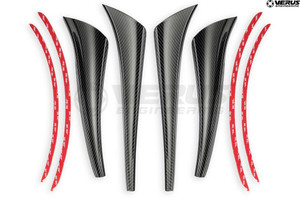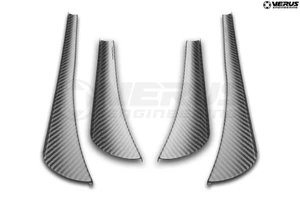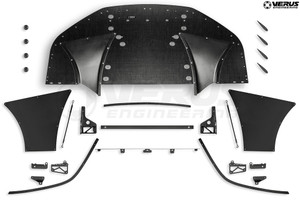


Description
The Verus Engineering Dual Element Dive Plane Kit for the Porsche 991.2 GT3 and GT3 RS is engineered to increase front-end downforce, improve high-pressure airflow into the factory intake duct, and maintain a minimal increase in aerodynamic drag.
These dual-element dive planes, also known as canards, allow you to shift the vehicle's aerodynamic balance forward without requiring a significantly larger front splitter. This makes them an effective solution for increasing high-speed front-end grip while maintaining street usability.
Depending on driver preference and the overall aerodynamic setup, these dive planes may provide sufficient front-end downforce without requiring additional rear aerodynamic components. Verus Engineering has observed up to 0.7-second gains in testing due to increased front-end grip in high-speed corners, allowing for greater cornering speeds. These results are performance observations and are not guaranteed for every vehicle or driver.
If additional rear stability is desired, Verus Engineering recommends pairing the dive planes with a rear aerodynamic device rather than running the dive planes alone.
The dive planes were designed in CAD using detailed vehicle scan data and optimized through Computational Fluid Dynamics (CFD) analysis in ANSYS Fluent.
Each dive plane is manufactured from 1.5mm thick 2x2 twill pre-preg carbon fiber, autoclave cured for consistent strength and quality. The components are available with either a matte or gloss UV-resistant automotive clear coat.
Fitment
- Make: Porsche
- Model: 911 GT3 / GT3 RS
- Generation: 991
- Chassis: 991.2
- Application: Porsche 991.2 GT3
- Application: Porsche 991.2 GT3 RS
- Position: Front
- Design: Dual-element dive plane / canard system
- Compatibility: Specifically designed for Porsche 991.2 GT3 and GT3 RS
What Is Included
- 1 Upper Left Dive Plane
- 1 Lower Left Dive Plane
- 1 Upper Right Dive Plane
- 1 Lower Right Dive Plane
- 1 Installation Template
- 4 Pieces of 3M VHB Double-Sided Tape, one for each dive plane
- Stainless mounting hardware
Key Features
- CFD optimized for improved aerodynamic performance
- Increases front-end downforce
- Shifts aerodynamic balance forward
- Improves front-end grip at high speeds
- Allows fine-tuning of aerodynamic balance toward a forward-biased setup
- Designed to help balance large rear wings and rear diffusers
- Improves high-pressure airflow to the factory intake duct
- Simple bolt-on or double-sided tape installation
- Installation templates included
- Designed for streetable and track-focused applications
Specifications
- Material: 2x2 twill pre-preg carbon fiber
- Thickness: 1.5mm
- Manufacturing: Autoclave cured
- Clear Coat: Matte or gloss UV-resistant automotive-grade clear
- Hardware: Stainless steel
- Installation: Bolt-on or 3M VHB double-sided tape
- Tape: 3M VHB, specifically cut to the dive plane dimensions
- Installation Aid: Custom installation templates included
- Design Method: CAD with vehicle scan data
- Aerodynamic Development: CFD optimized using ANSYS Fluent
What Do Dive Planes Actually Do?
Dive planes, commonly called canards, are aerodynamic devices positioned near the front corners of a vehicle. Their primary purpose is to generate additional front-end downforce and shift the vehicle's aerodynamic balance toward the front.
This allows the vehicle to gain additional front-end grip without requiring a substantially larger front splitter. For a Porsche 991.2 GT3 or GT3 RS running a large rear wing or diffuser, the added front downforce can help create a more balanced aerodynamic package.
Because a larger splitter can make street driving difficult, the Verus Engineering dual-element dive plane system provides an alternative way to increase front-end aerodynamic performance while maintaining a more street-friendly configuration.
Aerodynamic Science
The Dual Element Dive Plane Kit was developed to help fine-tune the aerodynamic balance of the Porsche 991.2 GT3 and GT3 RS.
By shifting aerodynamic load forward, the dive planes can help counteract the increased rear downforce generated by a large rear wing or diffuser. This allows the vehicle's aerodynamic balance to be adjusted without requiring an excessively large front splitter.
Verus Engineering developed the dual dive plane system to work effectively with its various Ventus aerodynamic kits for the Porsche GT3 and GT3 RS, allowing the components to function together as part of a balanced aerodynamic package.
The design was developed using vehicle scan data, CAD modeling, and CFD analysis in ANSYS Fluent to optimize aerodynamic performance.
Factory Intake Airflow Enhancement
In addition to generating front-end downforce, the dual dive plane system was designed to help direct clean, high-pressure airflow toward the factory intake ducts.
At high vehicle speeds, increased pressure at the intake can build within the intake system and create a small supercharge effect, or positive pressure within the intake manifold. According to Verus Engineering, this can help improve horsepower and torque.
The system also helps ensure that the Porsche 991.2 GT3 RS receives the coldest possible air at the intake filter, supporting consistent intake-air performance during high-speed driving.
Installation
The kit is designed for straightforward installation using the included templates and either bolt-on mounting or 3M VHB double-sided tape, depending on the installation configuration.
The included templates help position each dive plane accurately on the vehicle, while the pre-cut 3M VHB tape is sized specifically for the dive planes.
Ventus Aerodynamic Compatibility
The Verus Engineering Dual Element Dive Plane Kit was developed to work with the company's Ventus GT3 and GT3 RS aerodynamic packages.
When combined with complementary front and rear aerodynamic components, the dive planes can help fine-tune the overall aerodynamic balance and provide additional front-end grip to support a higher-downforce setup.