
Simpson Racing: Building a Complete Driver Restraint System
22nd Sep 2026
A racing harness is not an isolated upgrade.
Neither is a helmet or a head and neck restraint.
In a properly prepared track or competition vehicle, these components form a connected driver restraint system. The seat establishes the driver's position, the harness holds the body in place, the head and neck restraint manages the relationship between the helmet and torso, and the helmet provides the primary protective structure around the head.
Simpson Racing has spent decades developing these components for motorsport, with a product range covering racing helmets, harnesses, head and neck restraints, fire-resistant apparel, gloves, shoes, and other driver-safety equipment. Simpson traces its motorsport safety history back to 1959 and has developed equipment for disciplines ranging from drag racing to NASCAR and off-road competition.
For enthusiasts building a serious track car, understanding how these products work together is just as important as choosing the individual components.
Start With the Driver's Position
Before selecting restraint hardware, the cockpit itself needs to be considered.
The seat, seating position, harness mounting points, steering wheel, pedals, and roll-cage or harness-bar configuration all influence how the driver sits inside the vehicle.
A multi-point harness is designed to restrain the driver in a specific seating position. That makes correct installation and mounting geometry fundamental to the system.
Simpson offers different harness configurations and mounting styles, including bolt-in, floor-mount, wrap-around, and roll-bar mounting options. Its current harness catalog also includes 5-point, 6-point, and 7-point configurations.
The correct configuration therefore depends on the vehicle and its approved mounting points rather than simply choosing a harness based on appearance or buckle style.
Choosing the Right Harness Configuration
Simpson's racing harness lineup demonstrates why there is no single universal harness configuration for every build.
Its 5-point systems incorporate two shoulder belts, a lap belt, and an anti-submarine belt. Six- and seven-point configurations add additional restraint geometry for applications requiring it.
Different mounting configurations are also available.
Bolt-In Harnesses
Bolt-in systems attach directly to approved mounting points and provide a fixed installation arrangement.
Wrap-Around Harnesses
Wrap-around systems can be routed around approved chassis or roll-cage mounting points, providing installation flexibility where that mounting method is appropriate.
Roll-Bar and Harness-Bar Configurations
Some Simpson harnesses are designed specifically around roll-bar mounting, with V-type shoulder configurations and compatibility with head and neck restraint systems.
The mounting method should always follow the vehicle's chassis design and the manufacturer's installation requirements.
Harness Webbing Is Part of the Design
The harness itself is more than a collection of straps.
Current Simpson racing harnesses use different webbing configurations depending on the intended application. Some systems use 3-inch webbing throughout, while other designs combine 3-inch lap belts with narrower 2-inch shoulder belts for compatibility with head and neck restraint systems.
Hardware and adjuster design matter as well.
Simpson's current harness offerings include latch-and-link, lever camlock, and rotary camlock systems, allowing drivers to select different approaches to securing and releasing the restraint.
The choice should be based on the vehicle, sanctioning-body requirements, seating configuration, and the driver's complete restraint setup.
Head and Neck Restraint: The Next Layer
Once the driver is secured by a multi-point harness, head and neck protection becomes another important part of the system.
Simpson offers both HANS and Hybrid head and neck restraint designs. HANS devices use a yoke-style configuration, while Hybrid systems use a different structure designed to remain with the driver when entering or exiting the vehicle.
This distinction matters when choosing equipment because the restraint needs to work with the harness and helmet being used.
Simpson's current head and neck restraint catalog includes models carrying FIA and/or SFI certifications, with options spanning different designs, materials, and applications.
The Hybrid S Expands the Application
One particularly distinctive product in the Simpson lineup is the Hybrid S.
Unlike traditional HANS-style devices that are intended for multi-point harness environments, Simpson states that the Hybrid S is designed and tested for use with 3-point OEM seat belts as well.
That makes it relevant beyond dedicated race cars.
The Hybrid S can be particularly interesting for HPDE drivers, performance enthusiasts, instructors, and automotive test environments where the vehicle may retain its factory three-point restraint system.
Simpson also recommends using the Hybrid S within an appropriate complete cockpit setup, including a suitable helmet, seat, and restraint configuration.
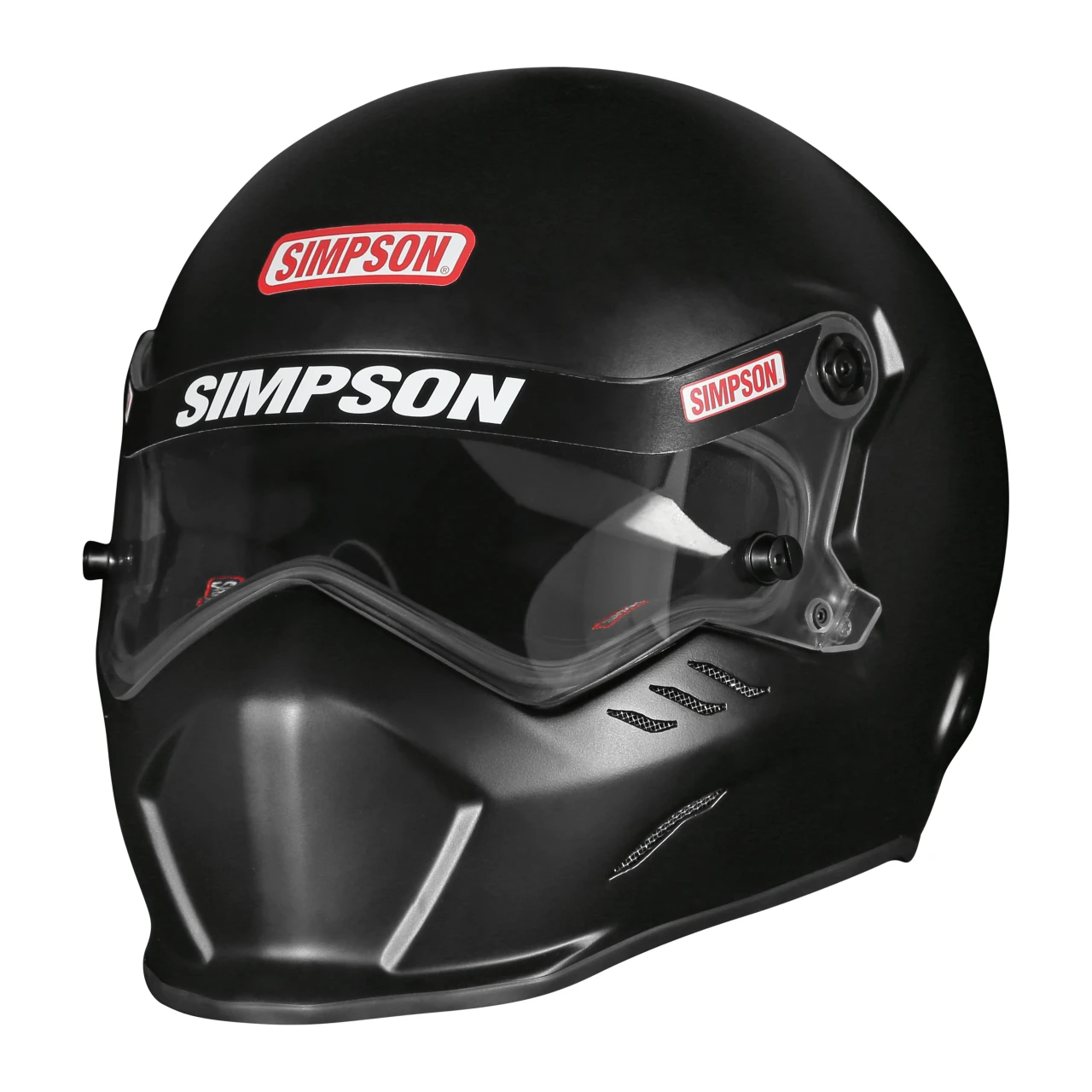
The Helmet Has to Match the System
The helmet is another component that should be selected as part of the overall setup.
Simpson's current auto-racing helmet range includes numerous Snell SA2020 and SA2025 options, with both composite and carbon-fiber shell constructions available. Many of the current models are also listed as compatible with head and neck restraints.
Current examples include the Vudo, Kingsnake, Bandit, SD1, and Diamondback families.
The certification required for a particular event should always be confirmed before purchasing, as competition organizations and classes can impose their own equipment requirements.
Why Compatibility Matters
It is possible to buy a high-quality helmet, harness, and head restraint individually and still end up with a poorly matched system.
The components need to work together.
For example, a harness may need a specific shoulder-belt width to accommodate a particular head and neck restraint. Simpson offers harnesses with 2-inch upper shoulder webbing specifically for compatibility with head and neck restraint systems.
Similarly, the helmet needs to be compatible with the restraint's tether system, while the seat and harness mounting geometry need to provide the correct relationship between the driver and the restraint.
This is why building the system first and shopping for individual pieces second can make the selection process considerably easier.
SFI and FIA Ratings Matter
Motorsport safety equipment is heavily dependent on certification.
A harness, helmet, or head and neck restraint may carry a specific SFI or FIA rating that determines where and how it can be used.
Simpson's current product range includes SFI 16.1 racing harnesses, SFI 38.1 head and neck restraints, and helmets carrying Snell SA certifications.
The important point is that certification should be checked against the rules of the specific event.
A product being designed for motorsport does not automatically mean that it is legal or accepted in every racing series or track-day program.
Installation Is Part of Safety
Even properly certified equipment depends on correct installation.
Simpson provides dedicated installation documentation covering harnesses, seating position and seat-belt installation, head and neck restraints, helmets, and other safety equipment.
Harness mounting points should be appropriate for the vehicle and installation method. Belt angles, routing, seating position, and interaction with the seat and head restraint all matter.
This is particularly important when a street vehicle is being converted into a track car, because the factory interior may not have been designed around a multi-point racing restraint system.
Driver Protection Beyond the Restraint System
The restraint system is only one part of Simpson's broader safety lineup.
The brand also produces racing suits, gloves, shoes, and other protective equipment intended for motorsport environments. Simpson's current product categories include helmets, head and neck restraints, fire suits, gloves, shoes, harnesses, and restraint systems.
That allows drivers to approach safety as a complete package rather than treating the harness or helmet as the only major consideration.
For competitive vehicles, the apparel and accessories should also be selected according to the applicable regulations and certification requirements.
Building Around the Type of Driving
A dedicated race car and a street-driven track-day car may require very different restraint strategies.
A competition vehicle with a roll cage, fixed-back racing seat, multi-point harness, and dedicated HANS device is a very different environment from a street car being driven on occasional HPDE events.
Simpson's range covers both ends of that spectrum.
The Hybrid S provides an example of equipment designed for applications retaining OEM three-point belts, while Simpson's extensive harness and HANS range provides solutions for dedicated multi-point racing configurations.
The correct system is therefore the one that matches the vehicle, driver, event, and applicable regulations.
Simpson Racing Safety Equipment at XPH
A performance vehicle can have the power, tires, brakes, and suspension to run hard on a circuit, but the driver needs an equally considered environment.
Simpson Racing approaches driver protection as a complete system, with components designed around restraint, head and neck protection, helmets, and protective apparel.
Whether you're preparing a dedicated competition car, building a serious track vehicle, or upgrading the safety equipment in a performance-driven street car, the key is to select compatible components and install them according to the applicable requirements.
Explore Simpson Racing at XPH
Extreme Power House offers Simpson Racing safety equipment including racing helmets, harnesses, head and neck restraints, and other motorsport driver-protection products.
Explore the Simpson Racing collection at XPH and build a driver restraint system around your vehicle and intended use: https://x-ph.com/simpson-racing/