
LIQUI MOLY Engine Oils: Choosing the Right Formula for Your Vehicle
16th Sep 2026
Engine oil is one of the simplest maintenance products to buy and one of the easiest to choose incorrectly.
A bottle marked 5W-30, 5W-40, or 0W-20 may look like a straightforward specification, but viscosity is only one part of the equation. Modern engines can require specific manufacturer approvals, emissions-system compatibility, additive technologies, and lubrication characteristics that make one oil appropriate for a particular application and unsuitable for another.
LIQUI MOLY approaches engine lubrication with a large range of formulations developed around different specifications and applications.
That variety is important because the best engine oil is not necessarily the thickest, newest, or most expensive option. It is the product that matches the engine's requirements.
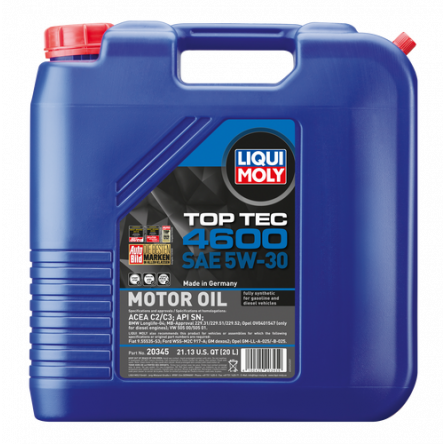
Viscosity Is Only the Starting Point
The numbers on an engine oil container describe how the oil behaves across different temperature ranges.
A 5W-30 and a 5W-40 are not simply two versions of the same oil with different thicknesses. They can have different specifications, approvals, additive packages, and intended applications.
LIQUI MOLY's current catalog includes a wide selection of engine oils covering numerous SAE viscosities and manufacturer specifications. Its product database lists hundreds of oils and numerous approvals and recommendations from automotive manufacturers and industry organizations.
This is why choosing oil should begin with the vehicle manufacturer's requirements rather than with viscosity alone.
Manufacturer Approvals Matter
Modern engines are designed around specific lubrication requirements.
Those requirements can include characteristics such as high-temperature stability, low-temperature flow, oxidation resistance, deposit control, fuel-economy considerations, and compatibility with emissions-control hardware.
LIQUI MOLY therefore lists manufacturer approvals and recommendations alongside its products.
For example, the LIQUI MOLY Molygen New Generation 5W-40 sold through XPH carries specifications and recommendations including BMW Longlife-01, MB 229.5, Porsche A40, Renault RN 0700/RN 0710, and VW 502 00/505 00, among others.
That does not mean the oil is automatically appropriate for every BMW, Porsche, Mercedes-Benz, Renault, or Volkswagen.
It means the listed approval or recommendation should be compared against the requirements for the specific engine.
Why Two Similar Oils Can Be Different
Two oils can share the same viscosity rating and still be designed for substantially different applications.
LIQUI MOLY's catalog demonstrates this clearly.
The company's range includes products carrying different ACEA and API classifications as well as numerous manufacturer-specific approvals. Its US catalog alone includes 74 engine oils, with specifications ranging across ACEA categories and manufacturer requirements.
This is particularly relevant for modern performance vehicles.
An engine designed around one manufacturer specification should not automatically receive another oil simply because both products happen to be 5W-30 or 5W-40.
The specification is part of the oil.
Synthetic Formulations for Modern Engines
LIQUI MOLY offers a broad selection of fully synthetic engine oils designed around different applications.
Its Molygen New Generation range, for example, uses the company's Molecular Friction Control technology and is offered in multiple viscosities. XPH currently carries Molygen New Generation 5W-30 and 5W-40 products.
The Molygen formulation is also recognizable by its fluorescent green appearance, which comes from the formulation's additive technology.
Other LIQUI MOLY formulations are designed around different manufacturer specifications and operating requirements.
The important takeaway is that the brand's range is intentionally diverse rather than built around one universal oil.
Performance Cars Need the Correct Oil, Not Just “Performance Oil”
Performance vehicles often create more demanding operating conditions, but that does not mean the solution is simply to use the highest viscosity available.
A turbocharged performance engine, for example, can experience high temperatures and significant loads while still requiring a specific low-viscosity oil because of its factory design.
Likewise, an older high-performance engine may have very different lubrication requirements from a modern turbocharged engine.
This is why oil selection should follow the engine's documented specification.
The fact that a vehicle is modified does not automatically make a particular viscosity or formulation appropriate.
Driving Conditions Can Change the Maintenance Strategy
The manufacturer's recommended oil specification remains the starting point, but the way a vehicle is used can influence maintenance requirements.
A vehicle that spends most of its time on long highway journeys experiences different conditions from one that repeatedly makes short trips through city traffic.
Likewise, repeated high-load driving, track sessions, extreme temperatures, or substantial modifications can place different demands on the lubrication system.
LIQUI MOLY itself highlights shortened oil-change intervals as a consideration for extreme loads, short distances, and difficult operating conditions.
That does not mean every performance car requires an arbitrary shortened interval.
Instead, it reinforces an important principle: oil selection and oil-change strategy should reflect the vehicle and how it is actually used.
Don't Ignore the Rest of the Lubrication System
Engine oil gets most of the attention, but the engine is only one part of a vehicle's drivetrain.
Manual transmissions, differentials, transfer cases, and other components can require their own dedicated lubricants.
LIQUI MOLY's range includes dedicated gear oils in different formulations and specifications. XPH, for example, carries LIQUI MOLY High Performance Gear Oil GL4+ SAE 75W-90, a fully synthetic transmission fluid designed for a variety of manual transmissions with an emphasis on shear stability, friction behavior, wear protection, and viscosity stability.
The same rule applies here:
Use the fluid specified for the component.
A gear oil should not be selected simply because its viscosity looks similar to another lubricant.
Additives Are a Separate Tool
LIQUI MOLY also offers a large range of additives, but additives should be viewed as targeted products rather than replacements for proper oil selection.
The company's current additive catalog includes gasoline, diesel, oil, and radiator additives, with products intended for different applications and specific maintenance concerns.
LIQUI MOLY's additive guide is structured around the vehicle, application area, and particular maintenance requirement before recommending a product.
That approach makes sense.
An oil additive intended for one purpose should not automatically be treated as a universal upgrade, and an additive cannot compensate for using an engine oil that does not meet the engine's required specification.
A Better Way to Choose LIQUI MOLY Oil
Instead of starting with the question, “Which LIQUI MOLY oil is best?”, start with a more useful sequence.
1. Identify the Engine
Confirm the exact vehicle, engine, model year, and relevant engine variant.
2. Check the Required Specification
Look at the owner's manual or manufacturer's technical documentation for the required oil specification and approvals.
3. Check the Viscosity
Once the required specification is known, identify the viscosity grades permitted for the application and the relevant operating conditions.
4. Compare Approved Products
Use LIQUI MOLY's product information to find formulations that meet the required specifications.
5. Consider How the Vehicle Is Used
Daily commuting, long-distance driving, short trips, modified engines, and repeated high-load use can all influence the appropriate maintenance strategy.
This process is more reliable than choosing an oil based solely on viscosity, price, or marketing claims.
LIQUI MOLY for Stock and Modified Vehicles
The advantage of a broad product range is that it can serve very different vehicles without pretending that they all need the same lubricant.
A stock daily driver may require one formulation.
A high-mileage performance car may have another requirement.
A modern turbocharged engine may demand a specific manufacturer approval.
A heavily modified vehicle may require particularly careful attention to its manufacturer's specifications and the conditions under which it is operated.
LIQUI MOLY's extensive range provides multiple formulations for these different requirements, rather than forcing every application into one generic product. The company currently lists more than 4,000 products across its global range.
The Right Oil Is the One That Fits the Application
Engine oil should not be treated as a universal performance upgrade.
The objective is compatibility.
The correct LIQUI MOLY product is the one whose specifications, approvals, viscosity, formulation, and intended application align with the engine and its operating requirements.
That approach gives enthusiasts a much better foundation for maintaining a performance vehicle than simply choosing the oil with the most aggressive-sounding description.
Explore LIQUI MOLY at XPH
Extreme Power House offers LIQUI MOLY engine oils, gear oils, additives, and other maintenance products for a wide range of automotive applications.
Whether you're servicing a daily driver, maintaining a performance BMW, preparing a modified vehicle for demanding use, or simply looking for the correct lubricant for your next service, explore the LIQUI MOLY collection at XPH: https://x-ph.com/liqui-moly-1/