DTE PowerControl RX for BMW XM & XM Label | X-PH
3rd Nov 2026
The BMW XM is already one of the most unconventional performance vehicles BMW M has produced.
It combines luxury-SUV proportions with a highly sophisticated electrified performance powertrain, substantial factory output, and the kind of acceleration normally associated with much smaller performance cars.
For owners who want even more from the combustion side of that package without moving directly into conventional ECU flash tuning, Extreme Power House now offers two dedicated DTE PowerControl RX performance modules:
- DTE PowerControl RX for the 2023–2026 BMW XM – DTEA103093
- DTE PowerControl RX for the 2024+ BMW XM Label – DTEA298898
Although the products use the same PowerControl RX technology, they are not the same tuning module.
DTE developed each application around its specific BMW XM configuration.
For the standard XM, DTE advertises gains of up to +114 BHP and +99 lb-ft of torque.
For the XM Label, DTE advertises gains of up to +112 BHP and +114 lb-ft of torque.
Both systems use plug-and-play vehicle-specific wiring, selectable driving modes, smartphone control, seven adjustment levels per mode, and reversible tuning that does not permanently overwrite the factory ECU software.
That makes PowerControl RX particularly interesting for XM owners who want stronger performance while retaining a tuning approach centered around the factory engine-management system.
What Is DTE PowerControl RX?
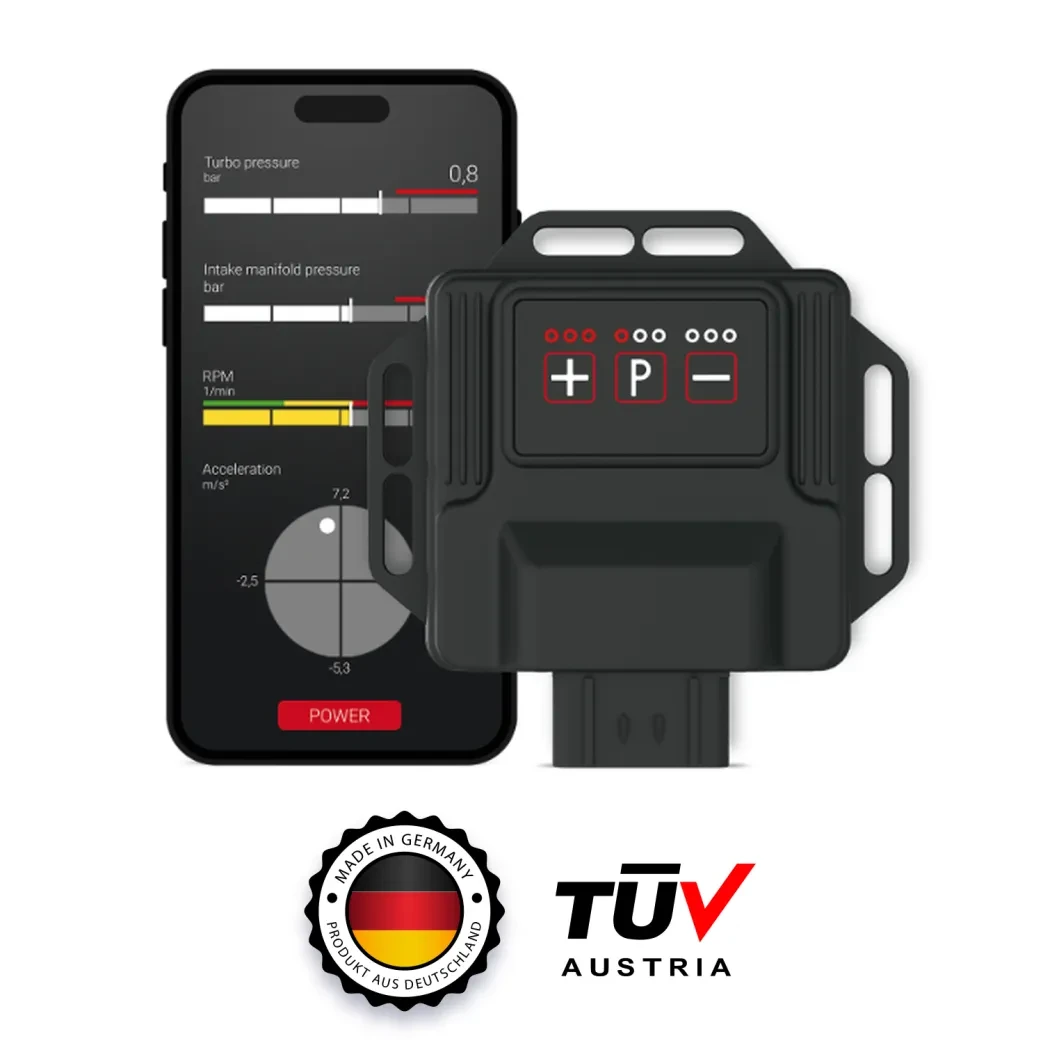
PowerControl RX is a vehicle-specific performance tuning module.
Rather than replacing the factory ECU software with a new flash file, the DTE system works externally with the existing engine-management architecture.
The module communicates through selected engine-control channels and adjusts relevant operating parameters according to its vehicle-specific calibration.
That distinction is important.
Traditional ECU flashing modifies software stored inside the vehicle’s engine control unit.
PowerControl RX takes a different route, allowing the original ECU software to remain in place.
For owners who value reversibility, that can be a major reason to consider a tuning module.
Performance Without Permanently Rewriting the Factory ECU
One of the core characteristics of both XM PowerControl RX applications is that the system does not permanently modify the factory ECU software.
DTE supplies the module with a vehicle-specific harness, allowing the system to be removed and the vehicle returned to its original configuration.
That does not mean aftermarket tuning should automatically be assumed invisible to manufacturer diagnostics or irrelevant to warranty considerations.
Any performance modification should be treated as a modification.
But mechanically, the PowerControl RX is designed around a much more reversible installation strategy than a permanent ECU software replacement.
DTE PowerControl RX for the 2023–2026 BMW XM
The first application is DTEA103093, developed specifically for the 2023–2026 BMW XM.
DTE lists performance gains of up to:
+114 BHP and +99 lb-ft of torque.
These figures are DTE’s published maximum gains for the supported application and should not be interpreted as guaranteed output for every individual vehicle.
Actual results can vary depending on vehicle condition, fuel, environmental conditions, factory software, and other variables.
Stronger Midrange Performance
Peak power gets most of the attention when discussing tuning, but on a large high-performance SUV, midrange acceleration can be just as important.
The XM is a heavy vehicle with enormous performance capability.
Additional torque through the middle of the rev range can make the vehicle feel more immediate during:
Highway passing.
Rolling acceleration.
Merging.
Corner exit.
And everyday part-throttle driving.
DTE specifically positions the PowerControl RX around stronger acceleration, pulling power, and improved in-gear performance rather than treating the upgrade as a dyno-number-only modification.
Up to 114 Additional BHP
The standard XM application carries the slightly higher horsepower figure of the two products.
DTE advertises up to +114 BHP for DTEA103093.
That is a substantial claimed increase from a plug-and-play tuning module.
Importantly, the published figure should be understood as an advertised gain for this specific XM application—not a universal PowerControl RX number that applies to every BMW.
DTE develops different calibrations for different engines and vehicle configurations.
Up to 99 LB-FT of Additional Torque
The standard XM PowerControl RX also carries a published maximum gain of +99 lb-ft of torque.
Additional torque can be particularly noticeable in a large SUV because it directly influences how strongly the vehicle accelerates without requiring the engine to remain at maximum RPM.
That can make the improvement feel useful far more often than only during full-throttle acceleration.
DTE PowerControl RX for the 2024+ BMW XM Label
The second module is DTEA298898, developed specifically for the 2024+ BMW XM Label.
DTE lists maximum gains of:
+112 BHP and +114 lb-ft of torque.
The XM Label module therefore has a slightly lower published peak horsepower increase than the standard XM application but a higher published torque increase.
Again, these figures belong specifically to the XM Label calibration and should not be transferred to the standard XM.
Up to 112 Additional BHP
For the XM Label, DTE advertises up to +112 BHP.
The difference compared with the standard XM tune is small on paper, but the more important point is that DTE does not treat the two vehicles as identical.
The module, part number, calibration, and published performance figures differ.
That is exactly what customers should expect from a vehicle-specific tuning solution.
Up to 114 LB-FT of Additional Torque
The XM Label application carries the larger torque figure:
Up to +114 lb-ft according to DTE.
For a performance SUV, that additional torque can translate into stronger acceleration when the driver asks for power without always needing to push the vehicle toward the top of the rev range.
That kind of response can matter both during aggressive driving and normal highway use.
Standard XM vs. XM Label: Choose the Correct Module
This is the most important fitment point.
These are two different DTE applications.
For a 2023–2026 BMW XM, the listed module is:
DTEA103093
For a 2024+ BMW XM Label, the listed module is:
DTEA298898.
Customers should not choose between them based on which published power figure they prefer.
The correct module must be selected according to the actual vehicle.
Why Vehicle-Specific Calibration Matters
Modern engines rely on a large network of sensors and control systems.
Boost.
Fueling.
Load.
Temperatures.
Torque requests.
Throttle behavior.
Safety strategies.
All interact continuously.
A performance module therefore needs to be calibrated around the exact vehicle rather than relying on one universal set of changes.
That becomes even more important on a sophisticated vehicle like the XM.
The standard XM and XM Label may belong to the same product family, but their factory configurations are different enough that DTE supplies separate modules.
Three Selectable Driving Modes
Both PowerControl RX systems give drivers access to three main operating modes:
Sport
Dynamic
and
Efficiency.
This allows the driver to change the tuning behavior without physically removing or reinstalling hardware.
Rather than having one fixed performance configuration active at all times, the PowerControl RX can be adapted to different situations.
Sport Mode
Sport Mode is the most performance-focused setting.
This is the mode intended for drivers who want the strongest response and most aggressive behavior available from the selected DTE configuration.
For spirited driving, stronger acceleration, or situations where maximum performance is the priority, Sport becomes the obvious choice.
Dynamic Mode
Dynamic Mode sits between the two extremes.
It is designed around stronger, more energetic response while remaining well suited to everyday driving.
For many XM owners, this could become the preferred general-use setting.
It gives the vehicle additional performance character without always running the most aggressive calibration.
Efficiency Mode
Efficiency Mode takes the opposite approach.
Instead of maximizing performance, it adjusts the tuning strategy with fuel economy and less aggressive driving in mind.
That gives the module more flexibility than a performance setting that remains permanently at maximum output.
Seven Fine-Tuning Levels Per Mode
The three driving modes are only the first layer of adjustment.
Each mode also provides seven fine-tuning levels.
That gives owners additional control over how aggressively the PowerControl RX operates.
Not every driver wants exactly the same response.
Not every road condition calls for maximum performance.
And not every vehicle behaves identically.
The additional adjustment range gives owners the ability to refine the module instead of being limited to only three fixed presets.
Smartphone App Control
PowerControl RX can be controlled through DTE’s smartphone application on compatible iOS and Android devices.
That puts tuning controls directly on the driver’s phone.
Owners can switch between the available modes without opening the hood or connecting a laptop.
For a modern luxury-performance SUV, that kind of interface feels much more appropriate than an old-style tuning box with physical switches hidden somewhere in the engine compartment.
Live Performance Instruments
The DTE app also provides access to supported live performance information.
That gives the driver additional insight into the tuning system and how the vehicle is operating.
The exact available information depends on the module and application, but the app makes PowerControl RX more than a simple install-and-forget box.
Warm-Up Timer
DTE also includes warm-up timer functionality through the app.
That is a useful feature on a high-performance engine.
Maximum performance should not be treated as something to demand immediately after a cold start.
Allowing fluids and engine components to reach appropriate operating temperatures is part of responsible performance driving.
Advanced Multimap Technology
DTE describes PowerControl RX as using advanced multimap, multi-channel, and multi-protocol technology.
In practical terms, this means the module is designed to work with multiple relevant engine-management signals rather than relying on one crude adjustment.
The calibration can therefore account for a broader range of operating conditions.
That helps the system deliver performance in a smoother, more progressive way rather than simply producing one fixed change everywhere.
Direct Battery Power Supply
Another notable detail is how PowerControl RX receives electrical power.
DTE supplies the system with a direct battery power source instead of relying on tapping a low-voltage sensor supply.
This provides stable voltage for the tuning module while avoiding unnecessary load on sensitive sensor circuits.
On a modern vehicle packed with sophisticated electronics, stable power delivery is an important part of module design.
Factory Protection Strategies Remain Active
DTE states that PowerControl RX is designed to retain the vehicle’s factory engine protection strategies.
That is an important distinction from older tuning methods that simply pushed engine signals without accounting properly for the factory control architecture.
Modern BMW powertrains continuously monitor operating conditions and use built-in safeguards to respond when necessary.
PowerControl RX is designed to operate within that broader factory system rather than replacing it entirely.
Plug-and-Play Installation
Both XM modules are supplied with vehicle-specific wiring harnesses and installation instructions.
DTE describes the system as plug-and-play, with no permanent ECU modification required.
That makes the hardware installation substantially different from an ECU unlock or conventional software flashing process.
The vehicle’s original ECU software remains intact.
No Special ECU Flashing Equipment Required
Because PowerControl RX is an external module, customers do not need to perform the same ECU flashing procedure associated with traditional software tuning.
That can be particularly attractive on newer vehicles where ECU security and unlock requirements may complicate conventional tuning.
The DTE approach avoids permanently replacing the factory calibration.
Fully Reversible
One of the biggest advantages of the system is reversibility.
If the owner wants to return the XM to its original configuration, the module can be removed and the original connections restored.
That makes PowerControl RX attractive for customers who are hesitant to permanently alter a relatively new or high-value vehicle.
Again, reversibility should not automatically be confused with guaranteed warranty invisibility.
But from a hardware and calibration standpoint, the original ECU file remains in place.
Designed for Everyday Use, Not Just Maximum Output
The XM is not a stripped-out track car.
It is a high-performance luxury SUV.
Owners may use it for:
Daily commuting.
Highway trips.
Family transportation.
Spirited driving.
Long-distance travel.
That makes drivability particularly important.
A tuning solution for the XM needs to do more than produce a dramatic peak-power number.
It needs to behave predictably when the driver is using only a fraction of the available performance.
That is where the combination of different modes and multiple adjustment levels becomes useful.
Stronger Acceleration Without Changing the Character of the XM
The goal of PowerControl RX is not to fundamentally turn the XM into a different kind of vehicle.
It remains a large, sophisticated BMW M SUV.
What changes is the performance available when the driver asks for it.
Additional horsepower can strengthen acceleration at higher load.
Additional torque can improve the way the vehicle pulls through the middle of the rev range.
Sharper response can make the powertrain feel more immediate.
For many owners, that is a more useful transformation than dramatically changing how the vehicle behaves at all times.
A Logical Upgrade for an Otherwise Stock XM
PowerControl RX does not require an extensively modified engine.
That makes it a realistic early performance upgrade for an otherwise stock XM.
An owner may want more power without immediately installing:
Downpipes.
Intakes.
Exhaust hardware.
Cooling modifications.
Or a permanent ECU calibration.
The DTE module offers a relatively straightforward starting point.
Also Relevant to Broader Performance Builds
At the same time, owners building a more extensively modified XM may also consider PowerControl RX as one part of the overall package.
Any combination with additional performance hardware should be evaluated carefully, however.
The tuning strategy needs to remain appropriate for the modifications installed.
A calibration intended around factory hardware should never automatically be assumed suitable for every major engine modification.
German Engineering and TÜV Certification
Both PowerControl RX applications are engineered and manufactured in Germany, and DTE lists TÜV certification as part of the product’s development credentials.
DTE also states that the tuning systems are dyno tested across multiple vehicle applications.
That vehicle-specific development is particularly important when dealing with high-output modern powertrains.
Five-Year Manufacturer Warranty
Both XM PowerControl RX systems are listed with a five-year DTE warranty.
Customers should review the current manufacturer warranty documentation for complete terms, coverage, exclusions, and requirements.
The warranty on the DTE product should also not automatically be confused with coverage of the entire vehicle.
30-Day Satisfaction Guarantee
DTE also lists a 30-day satisfaction guarantee for both modules.
Again, current manufacturer terms should be reviewed before purchase for full eligibility details.
Which DTE PowerControl RX Does Your BMW XM Need?
The choice comes down to the exact vehicle.
2023–2026 BMW XM
Use:
DTE PowerControl RX – DTEA103093
DTE-published maximum gains:
+114 BHP
+99 lb-ft
2024+ BMW XM Label
Use:
DTE PowerControl RX – DTEA298898
DTE-published maximum gains:
+112 BHP
+114 lb-ft
These modules should not be swapped simply because the vehicles belong to the same XM family.
Key PowerControl RX Features
Across the two XM applications, PowerControl RX provides:
- Vehicle-specific performance calibration
- Plug-and-play installation
- No permanent ECU software overwrite
- Three selectable driving modes
- Sport Mode
- Dynamic Mode
- Efficiency Mode
- Seven adjustment levels per mode
- iOS and Android app support
- Live performance instrumentation
- Warm-up timer functionality
- Advanced multimap technology
- Multi-channel and multi-protocol hardware
- Direct battery power supply
- Retention of factory engine-protection strategies
- Reversible installation
- German engineering and production
- TÜV certification
- Dyno-tested development
- Five-year manufacturer warranty
- 30-day satisfaction guarantee
The exact performance calibration remains specific to the standard XM or XM Label application.
Why a Tuning Module Makes Sense on the BMW XM
The XM is an unusual platform for performance modification.
It already combines enormous output with extremely sophisticated electronics.
That can make some owners hesitant to modify the factory ECU immediately.
A removable tuning module provides another route.
It allows the owner to pursue stronger engine performance while leaving the original ECU software in place.
For someone who wants an upgrade that feels less permanent, that can be particularly appealing.
Performance You Can Adjust
Another advantage is that the driver does not need to choose one permanent character.
Maximum performance for every drive is not always necessary.
Sport can be used when the driver wants the strongest response.
Dynamic can provide a more balanced setup.
Efficiency can take a more restrained approach.
And the seven individual adjustment levels provide another layer of customization.
That makes PowerControl RX more adaptable than a tuning solution with only one fixed operating profile.
XM Label Owners Need the Label-Specific Calibration
Because the XM Label sits at the top of the XM performance lineup, it may be tempting to assume that the standard XM PowerControl RX could simply be installed and adjusted upward.
That is not how these products are listed.
DTE supplies the DTEA298898 specifically for the XM Label.
The Label has its own published gain figures and vehicle-specific calibration.
Choosing the correct module is therefore essential.
Verify Vehicle Configuration Before Ordering
Before purchasing either PowerControl RX module, confirm:
- Exact BMW model
- Whether the vehicle is an XM or XM Label
- Model year
- Engine configuration
- Product part number
- Any existing performance modifications
For the standard XM, the XPH listing covers 2023–2026.
For the XM Label, the XPH listing covers 2024+.
Upgrade Your BMW XM at Extreme Power House
The BMW XM already offers extraordinary performance, but the DTE PowerControl RX provides an additional step for owners who want more acceleration, more torque, and more control over how their vehicle delivers its performance.
For the 2023–2026 BMW XM, DTEA103093 offers manufacturer-published gains of up to +114 BHP and +99 lb-ft of torque.
For the 2024+ BMW XM Label, DTEA298898 offers manufacturer-published gains of up to +112 BHP and +114 lb-ft of torque.
Both provide smartphone control, three operating modes, seven adjustment levels per mode, reversible plug-and-play installation, factory protection strategy retention, and German-engineered PowerControl RX hardware.
For owners who want more from the XM without immediately committing to a conventional ECU flash, DTE provides a compelling alternative.
Shop DTE PowerControl RX for BMW XM at Extreme Power House
DTE PowerControl RX – BMW XM 2023–2026 – DTEA103093
https://x-ph.com/dte-powercontrol-rx-for-the-bmw-xm-2023-2026-dtea103093/
DTE PowerControl RX – BMW XM Label 2024+ – DTEA298898
https://x-ph.com/dte-powercontrol-rx-for-the-bmw-xm-label-2024-dtea298898/