
Antigravity Batteries: Lightweight Power for Performance Builds
29th Sep 2026
Weight reduction is one of the most effective ways to change how a performance vehicle feels.
Removing weight from the body, wheels, interior, or suspension can improve the vehicle's overall dynamics, but not every weight-saving modification has to involve an expensive carbon-fiber component or a major change to the car.
The battery is one of the simplest places to start.
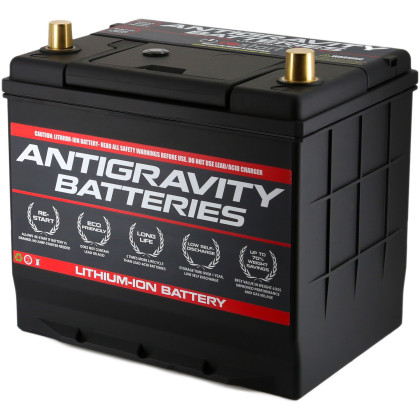
Antigravity Batteries specializes in lightweight lithium battery technology designed for automotive, powersport, racing, and performance applications. Its lineup combines significant weight savings with high cranking output, compact packaging, and, on RE-START models, built-in protection and emergency starting technology.
At XPH, Antigravity batteries provide an option for enthusiasts looking to reduce vehicle weight without giving up the starting performance expected from a modern performance battery.
Why the Battery Is an Interesting Place to Save Weight
A conventional lead-acid battery can represent a surprisingly large amount of mass in a vehicle.
Replacing it with a properly selected lithium battery can remove a substantial amount of weight from the car without changing the engine, suspension, or bodywork.
Antigravity's automotive RE-START batteries are designed as direct replacements for common OEM lead-acid battery sizes, including H5/Group 47, H6/Group 48, H7/Group 94R, H8/Group 49, and other applications. The company states that its automotive lithium batteries can be as much as 70% lighter than equivalent lead-acid batteries, depending on the model.
That makes the battery an unusually straightforward performance upgrade.
Instead of adding capability to the vehicle, the objective is to remove unnecessary mass while maintaining the electrical system's ability to start the engine.
Lightweight Does Not Mean Low Power
One of the common misconceptions about lithium batteries is that reducing weight necessarily means sacrificing starting performance.
Antigravity takes a different approach.
Its automotive RE-START lineup combines lithium chemistry with high cranking output. For example, the H8/Group 49 batteries are available in 60Ah and 80Ah configurations, with the 60Ah version rated at 1,800 cranking amps and the 80Ah version at approximately 2,000 cranking amps.
That combination is important for performance vehicles.
The goal isn't simply to install the smallest battery possible. It is to select a battery with sufficient capacity and starting output for the vehicle while taking advantage of lithium technology's lower mass.
RE-START Technology Adds a Different Kind of Security
Antigravity's RE-START technology addresses one of the biggest concerns associated with a battery: what happens if it becomes deeply discharged?
The RE-START system continuously monitors the battery and can place itself into a protective sleep mode when it detects over-discharge conditions while preserving enough reserve energy to restart the vehicle. Compatible automotive models can activate this reserve through a wireless key fob.
That means an accidental discharge does not necessarily turn into a roadside recovery situation.
For the automotive RE-START range, the technology can provide wireless emergency starting without requiring the owner to connect a separate jump pack or conventional jumper cables.
It is a useful example of how a performance component can also add functionality rather than simply removing weight.
Built-In Battery Management
Lithium battery technology requires careful management of the individual cells.
Antigravity's RE-START batteries incorporate a full onboard Battery Management System, including protections for over-discharge, over-charge, short circuits, and temperature conditions, along with cell balancing.
This is particularly important because a lithium battery is not simply a smaller version of a lead-acid battery.
The battery's electronics are part of the overall system.
The BMS monitors operating conditions and helps keep the battery within its intended operating parameters, adding another layer of protection to the lithium-cell design.
OEM-Size Options Make the Upgrade More Practical
Weight reduction is most useful when it does not require turning a simple modification into a fabrication project.
Antigravity's automotive RE-START range is available in common OEM battery case sizes, allowing many applications to use a direct-replacement format rather than a completely custom battery installation.
For example, the H7/Group 94R and H8/Group 49 formats are designed around common automotive dimensions and terminal arrangements. Antigravity states that its H7 and H8 batteries are direct replacements for the corresponding lead-acid battery sizes.
The exact battery still needs to be selected according to the vehicle and its electrical requirements.
Compact Batteries for Race and Performance Applications
Not every performance build needs an OEM-size battery.
Dedicated race cars and highly optimized street builds may prioritize minimum weight and compact packaging above all else.
Antigravity's smaller motorsport batteries are designed specifically for this type of application.
The AG-401, for example, is a compact lithium motorsport battery designed for race and performance applications where weight reduction and space savings are major priorities. XPH lists the AG-401 at only 2 pounds.
This type of battery can be particularly relevant for vehicles where the battery location has already been optimized or where the owner is willing to modify the mounting arrangement to achieve a lower overall vehicle weight.
Automotive and Powersport Applications
Antigravity's range extends well beyond conventional car batteries.
The company's catalog includes separate categories for automotive, motorcycles and powersports, small-case race batteries, OEM race batteries, extreme-power race batteries, and specialized-voltage batteries.
XPH carries products across this broader range, including compact ATX and ATZ batteries for motorcycles and powersport applications.
For example, the ATX12-RS is a lightweight replacement for the YTX12 battery format, with 360 cranking amps and a built-in BMS and RE-START technology.
The ATX30-RS similarly provides a higher-capacity option in the YTX30 case size, rated at 880 cranking amps and 32Ah PbEq.
This allows the same lightweight-battery philosophy to be applied across very different types of vehicles.
Heavy-Duty Lithium Options
Weight reduction does not always mean choosing the smallest available battery.
Some vehicles have greater electrical demands or require additional reserve capacity.
Antigravity's Heavy Duty models address this by increasing capacity and power while retaining the advantages of lithium construction.
The ATX20-HD, for example, is designed as a heavy-duty replacement for the YTX20 battery size and is rated at 900 cranking amps and 30Ah PbEq. XPH lists the battery at 5.18 pounds.
This provides another way to approach battery selection: choose the lightest battery that still provides the capacity and starting performance appropriate for the vehicle rather than assuming every build should use the smallest possible unit.
Battery Selection Still Matters
A lithium battery should not be selected purely by its weight.
The correct battery needs to match the vehicle's physical dimensions, terminal configuration, starting requirements, electrical system, and intended use.
This is particularly important on modern performance cars with substantial electrical loads and sophisticated charging systems.
Antigravity provides a battery finder covering cars, motorcycles, and powersport vehicles to help identify appropriate applications, while individual battery documentation provides additional installation and operating information.
For specialized race applications, the requirements can be different again.
The smallest and lightest battery may make sense on a dedicated competition car, while a street-driven vehicle may benefit more from an OEM-size RE-START battery with additional capacity and emergency-start functionality.
Weight Reduction That You Can Actually Feel
The appeal of a lightweight battery is not just the number on the scale.
Reducing vehicle mass can contribute to the overall dynamic balance of a performance build.
Less weight means less mass for the suspension to manage and less total vehicle mass to accelerate, brake, and change direction. The effect of one battery swap will naturally depend on the vehicle and how much weight is removed, but it can become especially valuable when combined with other sensible weight-reduction measures.
This makes the battery an excellent supporting modification for a broader performance strategy.
It does not replace suspension tuning, brake upgrades, or power modifications.
It complements them.
A Battery Upgrade That Fits Different Builds
Antigravity's range allows enthusiasts to approach the upgrade according to the vehicle.
A street-performance car can use an OEM-size RE-START battery with integrated BMS technology and emergency starting.
A heavily optimized build can use a compact motorsport battery where minimum weight and packaging are the priority.
A powersport application can use one of Antigravity's ATX or ATZ formats designed around common motorcycle and powersport battery sizes.
The underlying idea remains the same: high-output lithium technology in a much lighter package.
Explore Antigravity Batteries at XPH
Extreme Power House offers Antigravity Batteries for performance cars, race builds, motorcycles, and powersport applications.
Whether you're looking to remove unnecessary weight from a street car, build a lighter competition vehicle, or replace a conventional powersport battery with a modern lithium solution, explore the Antigravity Batteries collection at XPH: https://x-ph.com/antigravity-batteries/