

Description
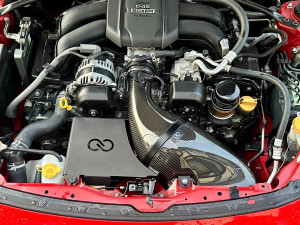
The Infinity Design Toyota GR Corolla Intake System is a performance-engineered cold air intake developed to overcome the factory intake system's airflow restrictions and improve turbocharger efficiency, power delivery, and performance consistency. Designed through computational fluid dynamics (CFD) analysis, extensive prototyping, and dyno testing, this upgraded intake system features a larger air filter, high-flow carbon-fibre airbox, smoother turbo inlet, redesigned intake tube, and a completely reengineered front intake duct.
By creating a more direct, controlled, and unrestricted airflow path from the front grille to the turbocharger, the Infinity Design GR Corolla Intake is designed to deliver cooler air, reduce intake restrictions, and improve performance under demanding driving conditions.
Dyno testing demonstrated a peak output of 273 WHP compared with 233 WHP from the factory intake during the initial comparison, representing a 40 WHP increase between the recorded peak figures. Testing also demonstrated a peak difference of up to 50 WHP at 6,000 RPM under heat-soaked conditions, alongside improved power consistency across repeated runs.
Important Fitment Note: 2025 and newer vehicles require tuning.
Key Features
-
Engineered specifically for the Toyota GR Corolla performance platform.
-
CFD-developed design refined through prototyping and dynamometer testing.
-
High-flow carbon-fibre airbox for improved airflow management.
-
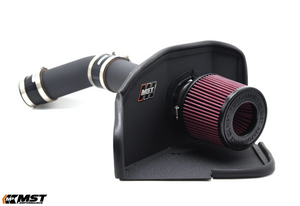
Larger 170 mm diameter air filter for increased flow capacity.
-
Progressive-taper intake tube designed to maintain smooth, high-volume airflow toward the mass airflow (MAF) sensor.
-
Smoother turbo inlet designed to reduce airflow restriction and pressure loss.
-
Redesigned front intake duct for a more direct supply of outside air.
-
Completely redesigned slam panel that seals directly against the front chassis and creates a dedicated high-flow pathway from the front grilles.
-
Improved cold-air delivery compared with the restrictive factory intake configuration.
-
Demonstrated improvements in power output and consistency during repeated dyno testing.
-
Lower recorded intake-air temperatures and reduced wastegate duty during testing.
-
Designed to support improved turbocharger efficiency and performance under sustained operating conditions.
-
Large air filter designed to provide exceptional airflow capacity while retaining a long service interval.
Design and Engineering
The Infinity Design GR Corolla Intake was engineered from the ground up with the goal of maximising airflow and turbocharger performance, from the front grille to the engine.
Every major component has been redesigned to improve the efficiency of the intake system. The smoother turbo inlet helps reduce restriction, while the intake tube features a progressive taper from the 170 mm diameter air filter to the mass airflow sensor. This design is intended to maintain smooth, high-volume airflow throughout the system.
The large air filter provides increased flow capacity while retaining a long service interval. At the front of the vehicle, the factory slam panel was identified as a significant airflow limitation. Rather than retaining the restrictive factory opening, Infinity Design developed a completely new slam panel that seals directly against the front chassis, creating a dedicated high-flow pathway that draws air directly from the front grilles.
This redesigned configuration is intended to supply the engine with a greater volume of cool, unrestricted air, reducing the need to compensate for limited front airflow by drawing hot air from the engine bay.
Factory Intake System and Limitations
The Toyota GR Corolla shares its engine with the GR Yaris and consequently uses a similar factory intake configuration. The original system consists of four main components: the turbo pipe, airbox, snorkel, and slam panel.
The factory intake system contains several features that can restrict airflow as engine demand increases:
-
Turbo pipe: Incorporates a large Helmholtz resonator to reduce intake noise, along with a tight-radius bend that disrupts airflow and contributes to pressure loss.
-
Airbox connection: Uses a long, corrugated EPDM hose. Its corrugated internal surface creates additional turbulence and restriction.
-
Airbox: Uses a horizontally mounted flat-panel filter, requiring airflow to make two 90-degree turns before reaching the intake tube.
-
Front air feed: The relatively small front feed limits the amount of air available to the engine.
-
Factory airflow flap: An additional flap opens at higher RPM to draw air directly from the engine bay. Although this increases available airflow, it can also increase intake-air temperature.
-
Snorkel: Feeds the airbox, which contains additional openings that allow hot engine-bay air to enter.
-
Slam panel: Provides limited airflow management, and its restricted opening limits the available cold-air supply.
Overall, the factory intake is designed around a balance of cost, packaging, noise reduction, and flexibility rather than maximum airflow performance. These design compromises create several potential restriction points that can limit the volume and quality of air reaching the engine, particularly as airflow demand increases at higher RPM.
Performance Testing and Dyno Results
The Infinity Design GR Corolla Intake was evaluated on a Dynojet 4WD-linked dynamometer inside a closed dyno cell equipped with a front-mounted cooling fan and a roof-mounted extraction system. All power figures are reported as wheel horsepower (WHP).
Testing conditions and procedures included:
-
The vehicle was brought to operating temperature and fully heat-soaked before testing each intake configuration.
-
Dyno cell temperature was maintained at approximately 2°C above ambient.
-
The same cell temperature conditions were replicated for both intake configurations to ensure a consistent comparison.
-
Three consecutive dyno runs were performed with each intake using the same test procedure.
-
The vehicle remained completely stock apart from the intake system.
-
99 RON fuel was used for all testing.
-
The left-hand graph represents the factory intake runs, while the right-hand graph represents the Infinity Design intake runs.
Initial Dyno Comparison
The factory intake baseline produced a peak output of 233 WHP. Although this is slightly below the commonly quoted stock figure of approximately 285 bhp, the supplied testing information indicates that 233 WHP is representative of typical performance for this vehicle.
The Infinity Design intake produced a peak output of 273 WHP, an increase of 40 WHP over the recorded factory baseline.
Across three consecutive runs, the factory intake demonstrated a progressive power reduction, with a peak difference of 9 WHP between the first and final runs. In comparison, the Infinity Design intake maintained substantially greater consistency, with a peak difference of just 2 WHP across the same testing procedure.
The dyno cell temperature remained consistent throughout testing, and the Infinity Design intake was tested at a temperature at least 1°C higher on every run. Despite these slightly higher temperatures, it maintained a more consistent power output.
This improved repeatability makes the intake relevant to track and drag racing applications, where maintaining consistent performance across repeated runs is important.
Heat-Soaked Performance Comparison
The final run from each intake configuration was compared to represent the vehicle under heat-soaked conditions.
The dyno graph showed a peak difference of 50 WHP at 6,000 RPM, with the Infinity Design intake producing more power from approximately 4,500 RPM onwards. This coincides with the point at which the factory airflow flap opens, allowing hot engine-bay air into the intake and highlighting the limitations of the factory airflow configuration.
Additional observations included:
-
Between 3,200 and 4,000 RPM, the Infinity Design intake produced approximately 10 WHP more, indicating improved turbo spool.
-
Between 4,000 and 4,300 RPM, a slight power dip of approximately 7 WHP was observed. This was attributed to the increased intake volume and the resulting reduction in airflow velocity.
-
The reduction in power after 6,800 RPM was attributed to throttle closure at higher RPM, a common issue encountered with the G16 engine during dyno testing.
-
The Infinity Design intake achieved these results despite the dyno cell temperature being 1.5°C higher during the test.
Validation on a Second GR Corolla
To further validate the results, Infinity Design tested the intake on a second Toyota GR Corolla using the same testing procedure.
The second vehicle produced a factory baseline of 236 WHP, just 3 WHP higher than the original vehicle, providing additional context for the typical output of the platform.
The same performance trends were observed:
-
The factory intake progressively lost power as the vehicle became heat-soaked.
-
The Infinity Design intake maintained a more consistent power output across repeated runs.
-
Throttle closure at higher RPM was more pronounced on the second vehicle, particularly with the Infinity Design intake. However, this behaviour does not occur during road driving.
-
The peak difference between the first runs was 40 WHP.
-
The difference between the third runs was again 50 WHP.
The consistency of these results across two separate vehicles provides additional validation of the performance improvements demonstrated during testing.
ECU Data Logging and Air Temperature Analysis
ECUTEK was used to data-log the vehicle with both the factory and Infinity Design intake systems on the dyno. Mass airflow (MAF) temperatures and manifold temperatures were recorded to provide further validation of the performance results.
MAF temperatures are particularly relevant because they represent the air entering the intake before intercooler heat soak.
MAF Temperature Results
With the factory intake, MAF temperatures continually increased as the system became heat-soaked. A significant temperature increase occurred from approximately 4,500 RPM when the factory flap opened and drew hot engine-bay air into the intake.
-
From 4,500 RPM to redline, MAF temperatures increased by approximately 15°C.
-
Between the first and final factory intake runs, temperatures increased by a further 5°C.
-
With the Infinity Design intake, temperatures remained consistent throughout testing.
-
At redline, MAF temperatures were approximately 25–30°C lower with the Infinity Design intake than with the factory system.
These temperature results support the dyno findings, particularly the increased power output from approximately 4,500 RPM onwards.
Manifold Temperature Results
Manifold temperatures remained consistently approximately 10°C lower with the Infinity Design intake compared with the factory intake.
However, manifold temperatures still increased during testing because of insufficient airflow over the intercooler, causing the intercooler to heat-soak.
Boost Pressure and Wastegate Duty Analysis
The recorded boost pressure and wastegate duty data provide additional insight into how the Infinity Design intake affects turbocharger operation.
Boost Pressure
-
Between 3,500 and 4,000 RPM, boost pressure was slightly higher than with the factory intake.
-
Between 4,000 and 4,500 RPM, boost pressure decreased, corresponding with the slight power dip observed in the dyno graph.
-
This mid-range behaviour was attributed to the larger intake volume, which reduces airflow velocity.
-
From 4,500 RPM onwards, boost pressure increased significantly.
-
A peak boost increase of approximately 0.4 bar was recorded, corresponding with the additional power output.
Wastegate Duty
Compared with the factory intake, the Infinity Design intake demonstrated lower wastegate duty throughout much of the tested RPM range:
-
From 2,500 to 5,000 RPM, wastegate duty was approximately 10% lower.
-
Between 5,500 and 6,500 RPM, wastegate duty was approximately 3% lower.
-
At redline, wastegate duty returned to approximately 10% lower.
Despite the lower wastegate duty, boost pressure was higher. This indicates that the turbocharger was able to produce more boost with less wastegate control during the test, supporting the conclusion that the redesigned intake system improves airflow efficiency and reduces the control effort required to achieve the ECU's boost target.
Air-Fuel Ratio Analysis
The air-fuel ratio (AFR) was also compared between the factory and Infinity Design intake configurations.
Both systems operated close to stoichiometric at lower RPM, before approximately 3,500 RPM. Beyond this point, both mixtures became significantly richer.
-
The factory intake operated at approximately 11.5 AFR following the transition to richer mixtures.
-
The Infinity Design intake maintained a slightly leaner mixture of approximately 12 AFR up to 5,500 RPM.
-
From 5,500 RPM onwards, the Infinity Design intake returned to approximately 11.5 AFR and remained consistent through to redline.
Although the Infinity Design intake operated slightly leaner than the factory system through the mid-range, the recorded AFR remained significantly richer than stoichiometric under load. The supplied testing data therefore indicates that the increased airflow did not result in an excessively lean mixture during the tested conditions, while maintaining the richer AFR used under high engine load.
Vehicle Fitment
Application: Toyota GR Corolla
Model year: 2025 and newer vehicles require tuning.
Upgrade your Toyota GR Corolla with the Infinity Design cold air intake featuring a high-flow carbon-fibre airbox, 170 mm air filter, redesigned turbo inlet and front duct. Dyno-tested for improved airflow, power and heat-soaked consistency. 2025+ vehicles require tuning.